Ask the internet what to automate first in a small business and you get 25-item listicles written for American SaaS companies. The real question has a one-line answer: automate the task with the fastest payback, and payback has a formula.
Payback rank = (hours saved per month × what the hour costs you) ÷ effort to set up. Run your task list through that, and the sequence chooses itself. Here’s what that looks like with real numbers.
What should I automate first in my small business?
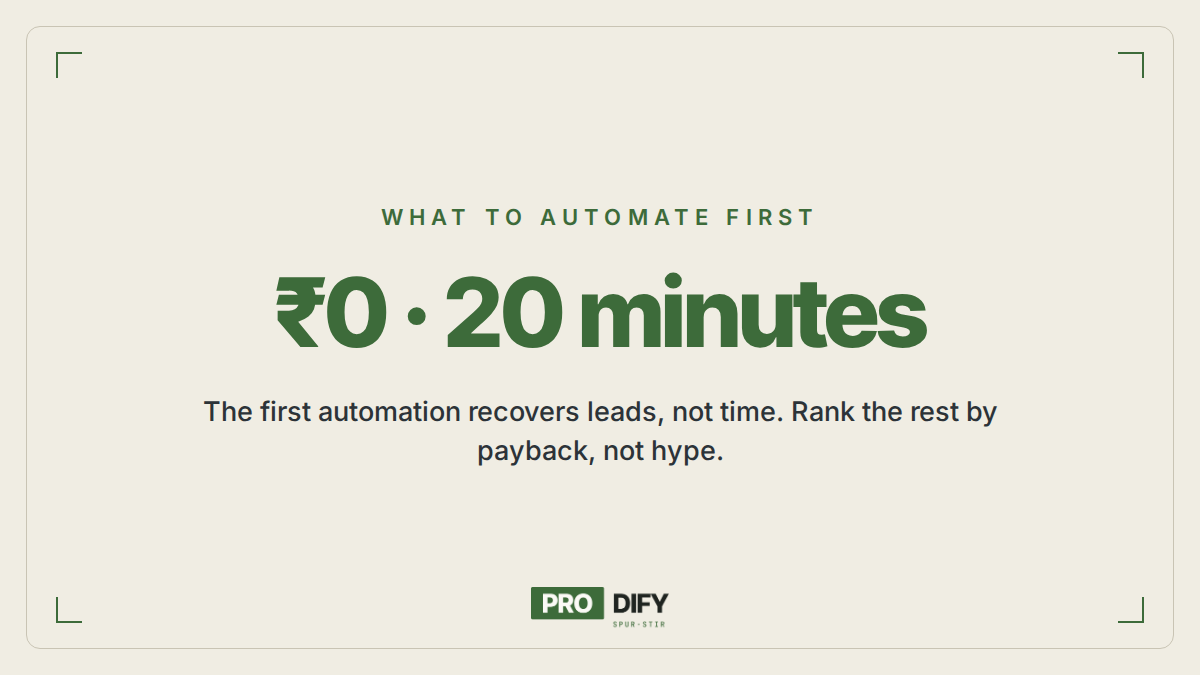
Automate lead response first. A lead that messages your business and waits four hours is a lead your competitor already answered. An instant auto-acknowledgment with a qualifying question costs ₹0 on the WhatsApp Business app, takes 20 minutes to set up, and typically recovers 2–5 leads a month that were dying of silence.
Why this beats everything else on payback: setup effort is nearly zero, and the return isn’t saved time — it’s recovered revenue. One recovered lead for a typical services business is worth ₹5,000 to ₹50,000. Nothing else on your list has that ratio.
The catch: an auto-reply only papers over the problem if your leads scatter across Meta ads, your website form, and three phones with no single record. Fix the routing along with the response — we’ve mapped that fully in the lead capture map for Indian SMBs.
Which four automations pay back fastest for most businesses?
In payback order: (1) instant lead acknowledgment — ₹0, 20 minutes; (2) payment reminders on unpaid invoices — Zoho Books at ₹749 a month or free via UPI app reminders; (3) appointment/order confirmations and follow-ups — WhatsApp templates; (4) daily sales/collections summary auto-sent to the owner — a Google Sheets script, ₹0.
Notice what’s on the list: money in, money owed, promises kept, and owner visibility. Notice what’s not: anything with the word “AI-powered” in its marketing.
The rupee math on #2, because owners consistently underrate it: if you’re a 15-person business with ₹8 lakh monthly billing and your receivables average 55 days, even a five-day improvement from systematic reminders frees roughly ₹1.3 lakh of working capital — permanently — for ₹749 a month. That’s the least glamorous automation you’ll ever build and possibly the highest-return one.
What goes inside the reminder matters as much as the schedule: for a registered MSME the payment deadline is 45 days by law, and putting that statutory due date and the interest clause into the template costs nothing but changes how fast the buyer’s accounts team moves your invoice up the queue.
What should I NOT automate first?
Don’t start with customer-facing chatbots or complex multi-tool workflows. Chatbots fail in month one because you haven’t documented your answers yet — automation can only repeat decisions you’ve already standardised. And multi-tool workflows fail silently, which costs more than doing the task manually ever did.
The chatbot trap deserves one more sentence: a bot that answers 60% of queries and fumbles the handoff on the rest creates more anger than it saves labour. Get your SOPs and escalation rules written first; the bot comes after, if at all — and half the time what you need isn’t an AI agent anyway.
Should I use no-code tools or get custom automation built?
For your first three automations, no-code or native features win — WhatsApp quick replies, Zoho Books reminders, Google Sheets scripts. The crossover to custom code comes with volume: no-code platforms charge per task executed, so a workflow running 3,000 times a month can cost more on Zapier than a one-time custom script.
We’ve seen the pathological case up close: a founder paying ₹2,400 a month for a Zapier workflow that ran nineteen times — ₹126 per execution to copy a row into an email. Before you subscribe to anything, run the five-question Zapier-vs-code test. And before you automate anything at all, ask whether the process deserves to exist — automation multiplies whatever it touches, including broken processes.
How do I know if an automation is actually working?
Give every automation one number before you build it: leads answered within a minute, average days to payment, no-show rate. Check the number after 30 days. No movement means switch it off — an automation that saves no measurable time or money is a hobby with a subscription fee.
This one-number rule also kills scope creep. The moment someone says “while we’re at it, let’s also connect it to…” — stop. Ship the single automation, measure for a month, then decide. Sequential boring wins compound; parallel ambitious projects stall.
FAQ
What’s the cheapest useful automation for a small business?
WhatsApp Business app auto-replies and quick replies — usually the whole answer to what to automate first in a small business. ₹0, set up in 20 minutes, and they answer the top repeated questions plus acknowledge every lead instantly.
How much should a small business budget for automation?
Start at ₹0–₹1,000 a month using native features (WhatsApp Business, Zoho Books reminders, Google Sheets). Cross ₹5,000 a month only when a measured automation is already paying for itself and volume justifies dedicated tooling.
Which tasks should never be automated?
Anything requiring judgment you haven’t written down yet — complaint resolution, discount decisions, hiring. Automate the standardised 80%; route the exceptions to a human with a clear escalation rule.
Want your task list ranked by payback? Send it to us on WhatsApp — ten tasks, and we’ll tell you the order and the tools, with the math shown.
1 thought on “What Should I Automate First in My Small Business? Rank by Payback, Not by Hype”
Comments are closed.