
Every founder eventually asks the same question: how do I make my business less dependent on me? Start with this test: switch your phone off for one full working day. If the honest answer is “I can’t,” you don’t own a business. You own a job that happens to have staff.
Most Indian SMB owners fail this test, and the reason is rarely laziness or bad hiring. It’s that every process in the company quietly routes through one node: you. Price approval? You. Vendor fight? You. “Sir, customer is asking something different”? You. The company isn’t structured around systems; it’s structured around your availability.
Here is the 90-day sequence we use to remove that single point of failure.
How do I make my business less dependent on me?
Stop being the answer machine. For 90 days: log every decision that reaches you (weeks 1–2), write rules for the repeating ones (weeks 3–6), delegate each rule to a named owner with clear escalation limits (weeks 7–10), then physically leave for two days and watch what breaks (weeks 11–12).
Notice the order. Owners usually start with delegation — “I’ll hand off tasks” — and it collapses in a fortnight, because they delegated work without delegating decisions. The employee still walks over for every judgment call. You haven’t removed the bottleneck; you’ve added a queue in front of it.
Why does everything in my company come to me?
Because answering is faster than teaching, and you’ve been choosing fast for years. Every time you answer instead of writing the rule, you buy ten minutes today and sell tomorrow. Your team isn’t incapable; they’re trained. Asking you IS the process — it’s just an undocumented one.
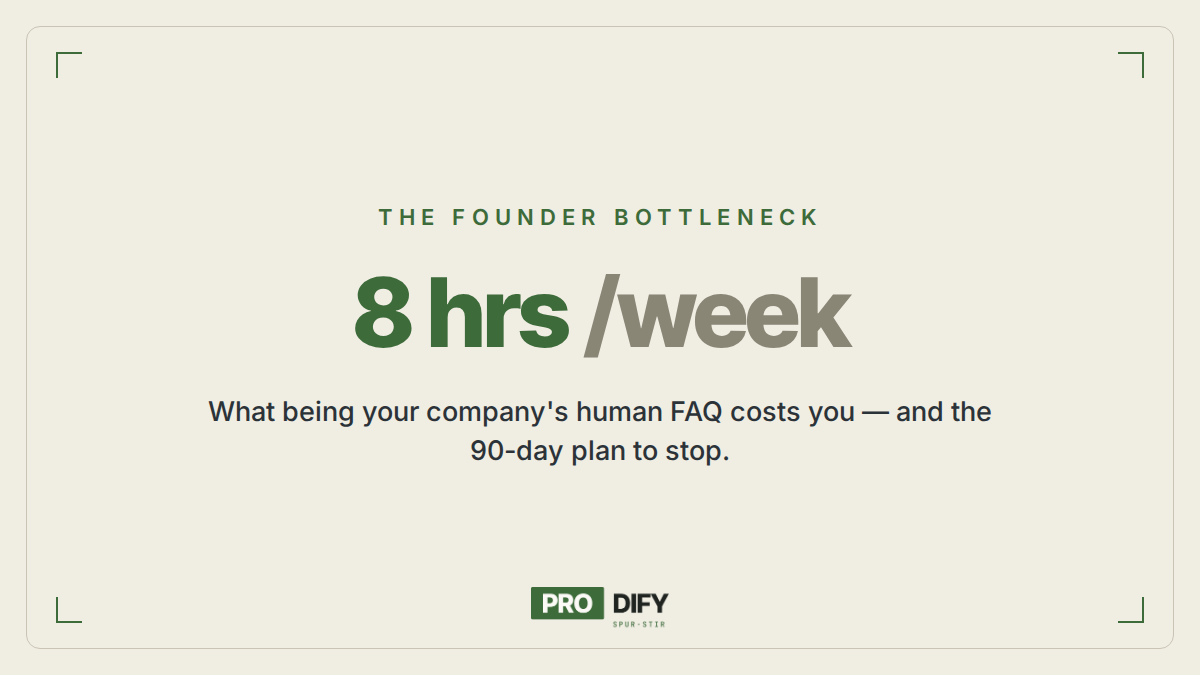
There’s a compounding cost here that owners don’t price. Each interruption is small, ₹0 on paper. But if 20 decisions a day route through you at even 5 minutes each, that’s over 8 hours a week of founder time spent re-answering questions you’ve answered before. At any honest valuation of your hour, that’s ₹3–5 lakh a year of leadership attention spent being a human FAQ.
Price that hour properly and the number gets worse: at ₹2 crore revenue and 70-hour weeks, your implied rate is about ₹5,500 an hour, so 25 hours a week spent on ₹300-an-hour work leaks roughly ₹65 lakh a year — that is the founder hourly-rate test, and it decides whether an operations manager at ₹6–12 lakh a year is a cost or a discount.
What is a decision log and how do I run one?
A decision log is a simple record of every question that reaches you: what was asked, who asked, what you decided, and whether it’s a repeat. Run it in a free Google Sheet for two weeks. Most founders find 60 to 70% of entries are repeats — those repeats are your delegation list.
Four columns. Date, question, decision, repeat (Y/N). Nothing fancier — the moment the log needs its own training session, you’ve defeated the purpose.
At the end of two weeks, sort by repeat. The pattern is always the same: discount approvals, refund calls, vendor payment timing, “can we promise this delivery date,” leave requests. These aren’t strategic decisions. They’re rules you haven’t written yet.
How do I delegate decisions without losing control?
Delegate with limits, not with hope. Each rule gets a named owner and an escalation threshold: “You approve refunds up to ₹2,000. Between ₹2,000 and ₹10,000, decide but inform me same day. Above ₹10,000, ask first.” Control isn’t lost — it’s re-priced to only the decisions that deserve you.
This threshold structure does something psychological that blanket delegation doesn’t: it gives your team a safe zone. Indian SMB employees often escalate everything not because they can’t decide, but because deciding wrongly has unclear consequences. A written threshold converts “will sir be angry?” into “am I within my limit?” One is fear; the other is a system. We’ve written before about how sales teams aren’t lazy, they’re system-starved — the same is true of your managers.
The ₹0 stack for all of this: Google Sheets for the decision log, Google Docs for the rulebook, WhatsApp for escalations (a dedicated group named “Escalations Only” — if it’s not above threshold, it doesn’t belong there). No software purchase required. The constraint was never tooling.
What should still depend on the founder?
Three things should stay with you: direction (what we sell, to whom, at what price philosophy), key relationships (the five customers or partners who move your revenue), and standards (what “good” looks like). Everything else — execution, exceptions within limits, daily judgment — should run on written rules.
A useful frame from our own vocabulary: thehrav — the deliberate pause. Founders who never pause can’t see which of their daily decisions are actually direction and which are just noise wearing urgency’s clothes. The 90-day plan is, at its core, a forced thehrav.
How do I test whether it worked?
Leave. Two consecutive working days, phone off, no check-ins, in month three. Then read the escalation group and the decision log when you return. Every mess you find is not a failure — it’s the next rule to write. Repeat quarterly until the two-day absence is boring.
The end state isn’t a business that never needs you. It’s a business that needs you for the right ten decisions a month instead of the wrong two hundred a week.
FAQ
How long does it take to make a business founder-independent?
The bottleneck-removal basics take 90 days of honest effort. Full independence — where the business grows without you in daily operations — typically takes 12 to 24 months of repeating the log-rule-delegate cycle each quarter.
What if my team is too junior to take decisions?
Then delegate smaller thresholds, not zero thresholds. A junior manager with a ₹500 limit still removes twenty interruptions a week. Raise the limit as the log proves their judgment.
Do I need to hire a COO or manager first?
No. Write the rules first. A manager hired into a rule-less business becomes another queue in front of you — now the questions just travel through one extra person before reaching you anyway.
If you want a second pair of eyes on your decision log — what to delegate, what to keep, where the thresholds should sit — WhatsApp us. We do this exercise with founders every month.

1 thought on “How Do I Make My Business Less Dependent on Me? A 90-Day Plan for Indian Founders”
Comments are closed.