Search “WhatsApp Business API pricing India” and read the top five results. Now check who wrote them: AiSensy, MyOperator, mtalkz — all Business Solution Providers whose revenue depends on you signing up. The information is mostly accurate. The framing is never neutral.
So here is the neutral version: what it costs in 2026, what’s genuinely free, and the honest volume threshold below which the free app is the smarter choice.
Is WhatsApp Business API worth it for a small business in India?
Worth it if you send 3,000+ outbound messages a month, have more than 2 people replying to customers, or run Click-to-WhatsApp ads. Below that, the free WhatsApp Business app does the job. The API’s real cost for a small sender is roughly ₹5,500–₹6,000 a month all-in — it must earn that back in saved staff time or recovered leads.
That’s the whole decision in one paragraph. The rest of this post is the math behind it.
What does WhatsApp Business API actually cost in 2026?
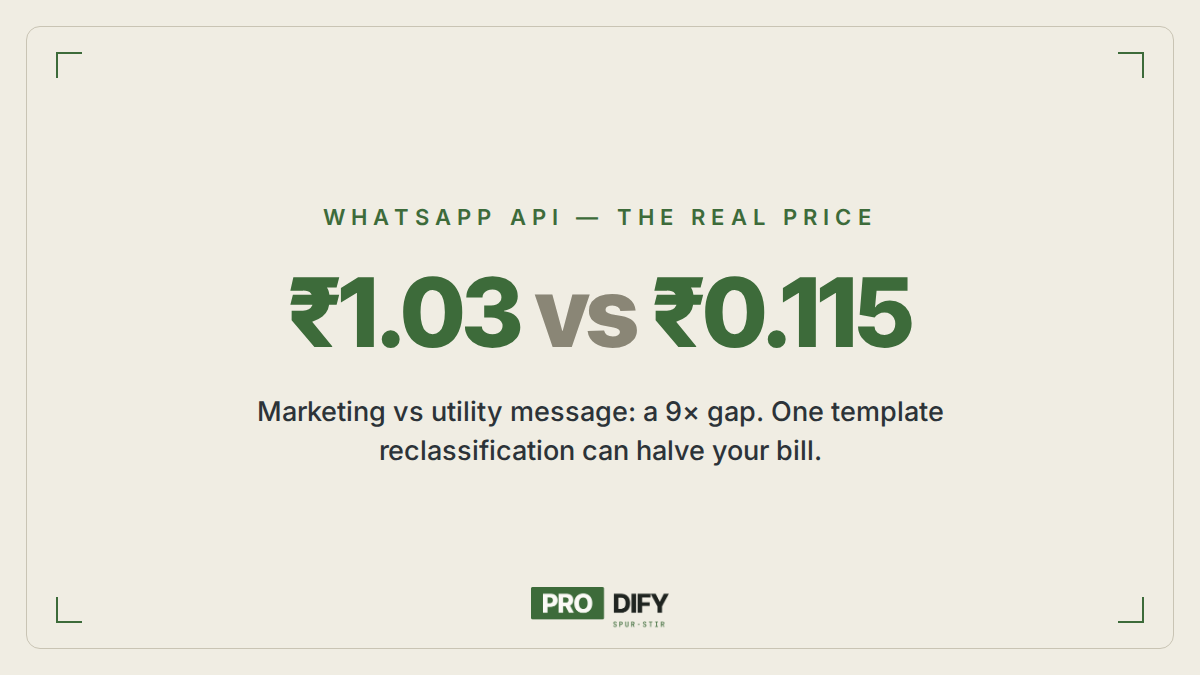
Meta bills per message since July 2025. Current India rates as of July 2026: marketing messages approximately ₹1.03 each, utility and authentication messages ₹0.115 each, and service replies within the 24-hour customer window are free. On top of Meta’s rates, your BSP adds either a per-message markup (₹0.10–₹0.30) or a platform fee of ₹999–₹9,999 a month — plus 18% GST on everything.
Realistic monthly totals at a typical 60/40 marketing-to-utility mix (assuming a ₹999 platform fee, ₹0.10 per-message markup, and GST):
- 5,000 messages a month: around ₹5,700
- 25,000 messages a month: around ₹23,700
- 1,00,000 messages a month: around ₹91,300
Note the trend, too: the marketing rate has climbed from ₹0.86 to about ₹1.03 within a year. Meta keeps repricing the message class businesses overuse — which makes the next point worth more every quarter.
The single most expensive mistake owners make: treating all messages as equal. A marketing template now costs 9 times a utility message (₹1.03 vs ₹0.115). Reclassify your order updates, payment reminders, and delivery notifications as proper utility templates and a sloppy ₹25,000 marketing-heavy bill can drop by half.
What’s free on the API (and how do you exploit it)?
Two windows are free: any reply within 24 hours of a customer messaging you (service window), and all messages for 72 hours after someone clicks a Click-to-WhatsApp ad. A business that engineers its flows to get customers to message first converts most of its conversation volume to ₹0.
This is the part vendor blogs under-explain, because free messages don’t earn them markup. Practical exploitation: put “WhatsApp us” buttons everywhere (website, Google Business Profile, packaging, invoices), run CTWA ads instead of broadcast blasts, and design your campaigns so the customer initiates. Inbound-first isn’t just cheaper — inbound leads close better anyway.
When is the free WhatsApp Business app enough?
The free app is enough when one or two people handle all customer chats, your outbound is under roughly 100 messages a day, and you don’t need automation beyond quick replies and a catalog. Its hard limits: 256 contacts per broadcast list, no multi-agent inbox at scale, no chatbot, no CRM integration.
A practical note on the broadcast limit: 256 per list, but nothing stops you from maintaining multiple lists. A shop messaging 800 customers a month with offers can run four lists at ₹0 forever. Clunky, yes. But clunky and free beats elegant and ₹6,000 a month when margins are tight. That said — if you’re juggling seven broadcast lists and three phones, you’ve already outgrown the app; you’re just paying the cost in staff time instead of an invoice.
What ROI justifies the API cost?
At ₹6,000 a month, the API needs to recover roughly ₹200 a day. That’s one saved lead for most services businesses, or 30–40 minutes of staff time at typical Indian SMB wages. If automation catches even a fraction of the enquiries currently dying in a personal phone’s inbox after 8 pm, the API pays for itself in week one.
But be honest about where your leads actually leak. Most businesses that come to us convinced they need the API actually have a routing problem: leads arrive on Meta ads, Google, a website form, and the owner’s personal WhatsApp, and nobody can say where a given customer came from. The API won’t fix that — a lead capture map will. And if you’re buying the API for a chatbot, first read our piece on the 40% of conversations the bot can’t handle — the handoff design matters more than the bot.
How do you choose a BSP without getting overcharged?
Compare on three numbers only: per-message markup on marketing messages, monthly platform fee, and what’s charged for service-window (free-from-Meta) messages — some BSPs quietly bill you for messages Meta gives away. Get all three in writing before any demo. A fair 2026 deal for a small sender: under ₹0.15 markup and under ₹2,500 platform fee.
Meta’s own rates are identical through every BSP. Everything above Meta’s rate is the BSP’s margin — negotiate it like you’d negotiate any vendor’s margin.
FAQ
How much does WhatsApp Business API cost per message in India?
Meta’s India rates as of July 2026: approximately ₹1.03 for marketing, ₹0.115 for utility and authentication, ₹0 for service replies within the 24-hour window. BSPs add ₹0.10–₹0.30 markup or a monthly platform fee, plus 18% GST.
Is the WhatsApp Business app free for business use?
Yes, fully free — including catalog, quick replies, and broadcast lists of up to 256 contacts. You pay nothing until you move to the API.
Can I start on the free app and upgrade later?
Yes, and you should. Move to the API when volume crosses ~3,000 outbound messages a month or when more than two people need to reply from one number. Your number can be migrated to the API; note that some history and app-specific features don’t carry over, so plan the switch rather than drifting into it.
Not sure which side of the breakeven you’re on? Send us your monthly message volume and team size on WhatsApp — we’ll do the math with you, and we don’t sell API subscriptions.