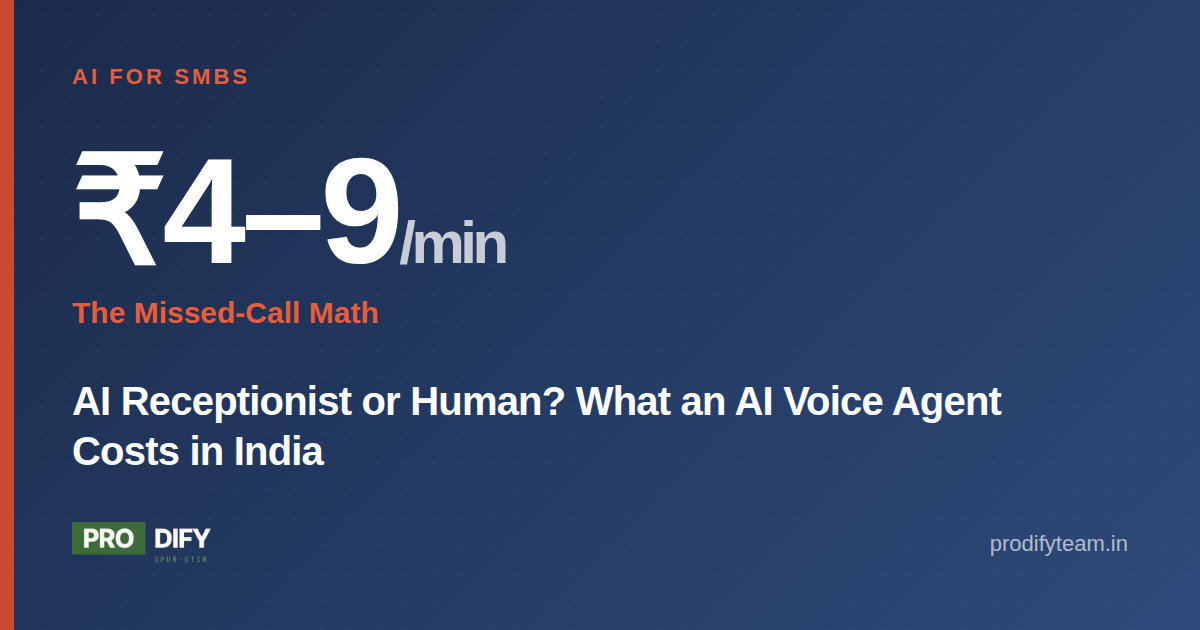
Short answer: if your business misses more than 10 calls a day, an AI voice agent is probably worth it. The AI voice agent cost in India runs roughly ₹4–9 per minute of talk time, with entry plans running about ₹3,000–10,000 per month, against ₹15,000–18,000 per month for a human receptionist who works one shift, takes weekly offs, and cannot answer two calls at once. Below that call volume, or if your sales conversations are genuinely consultative, keep the human and save your money.
That’s the answer. Now here’s the thinking behind it, because the decision is not about technology at all. It’s arithmetic.
Here is the missed-call math: multiply your missed calls per day by your lead-to-sale conversion rate by your average ticket size; if that number beats the per-call price of an AI agent, you are already paying for the AI — you’re just paying it in lost customers.
Most Indian SMB owners have never done this multiplication. They know calls get missed. Lunch hour, second shift, Sunday, the receptionist on leave, two calls landing at once. But the losses never show up in Tally, so they feel like weather instead of a line item. Let’s make them a line item.
How much revenue are missed calls actually costing you?
Multiply your missed calls per day by your conversion rate by your average ticket, then by 30. A dental clinic missing 8 calls a day, converting 20% at a ₹800 ticket, loses ₹1,280 daily and about ₹38,400 a month. An AI agent covering those calls costs ₹5,000–8,000 all-in.
Take a dental clinic in Indore. The front desk is staffed 10 a.m. to 7 p.m., six days a week. The owner pulls the call log from her telecom provider and finds something uncomfortable: 8 calls a day ring out unanswered. Evenings, lunch, and the Tuesday rush when the receptionist is juggling billing.
Run the math:
- 8 missed calls a day. Not all are patients. Some are couriers, some are wrong numbers. Be conservative and say all 8 are counted anyway.
- 20% would have booked. For a clinic, someone calling to ask about a root canal has high intent. One in five converting is a modest assumption.
- ₹800 average ticket. A basic consult plus a cleaning or an X-ray.
8 × 20% × ₹800 = ₹1,280 lost per day. Over a 30-day month, that is roughly ₹38,400 in revenue walking out the door, silently, every month. No invoice, no alert, no entry in the books. Just patients who called the clinic across the road instead, because that clinic picked up.
Now price the fix. An AI voice agent handling those 8 calls at 2 minutes each, at ₹6 per minute, costs about ₹96 a day, under ₹3,000 a month in talk time. Add a platform fee and you’re at ₹5,000–8,000 a month all-in. Spending ₹8,000 to recover ₹38,000 is not a technology decision. It is the easiest ROI calculation you will make this year.
What does an AI voice agent cost in India in 2026?
AI voice agents in India cost ₹4–9 per minute of talk time, with entry and mid-tier monthly plans at ₹3,000–10,000 that bundle minutes, a business number, and CRM or WhatsApp integrations. Setup runs free to ₹15,000 one-time. Custom enterprise builds go past ₹25,000, which a 10-person business does not need.
Three numbers to hold in your head:
- Per-minute pricing: ₹4–9 per minute of AI talk time on most India-focused platforms. Global platforms priced in dollars land in a similar band ($0.05–0.12/min) once you convert, though telephony charges for Indian numbers can add up.
- Monthly plans: ₹3,000–10,000 for entry and mid tiers that bundle minutes, a business number, and CRM or WhatsApp integrations. Custom enterprise builds go well past ₹25,000, but a 10-person business doesn’t need those.
- Setup: often free to ₹15,000 one-time, depending on how much workflow customisation you want (appointment booking into your calendar, lead capture into your sheet, escalation rules).
Compare with the human option: a receptionist in a tier-2 city costs ₹15,000–18,000 a month, more in metros. She works roughly 26 days and 9 hours a day, which means about 234 hours of coverage out of the 720 hours in a month. Every hour outside that window, you’re unstaffed. The AI works all 720, never calls in sick before Diwali, and handles five simultaneous callers without putting anyone on hold.
This is not an argument for firing your receptionist. In most businesses we’ve seen, the right answer is both: the AI catches overflow, after-hours, and holidays; the human handles walk-ins, billing, and the calls that need warmth. The comparison that matters is not AI versus human. It is AI versus nobody, because nobody is who’s answering your phone at 8:30 p.m. right now.
The breakeven formula, explicitly
Write this on a whiteboard:
Monthly loss = missed calls/day × conversion rate × average ticket × 30
If monthly loss > monthly AI cost → the agent pays for itself. If not → skip it.
Plug in your own numbers. A CA firm missing 4 calls a day with a ₹15,000 average engagement and even a 10% conversion is losing ₹1.8 lakh a month. A tiffin service missing 15 calls at ₹120 a ticket and 30% conversion loses about ₹16,000. Both clear the bar. A boutique missing 2 calls a day at ₹2,000 tickets and 10% conversion loses ₹12,000, which clears a ₹5,000 plan but not a ₹15,000 custom build. The formula tells you not just whether to buy, but how much you can afford to spend.
When should you NOT get an AI voice agent?
Skip an AI voice agent if you get fewer than 10 calls a day, because a ₹6,000 plan to recover ₹4,000 is a subscription, not a solution. Also skip it if your sales are consultative, like interior design or wealth management, or if your customers hang up on bots. Run the Hinglish test before signing.
Here is where most vendor content goes quiet, so let’s be honest.
Skip it if you get fewer than 10 calls a day. At 5 calls a day with maybe 1 missed, you’re recovering a few thousand rupees a month at best. A ₹6,000 plan to recover ₹4,000 is a subscription, not a solution. A simple missed-call auto-SMS with a WhatsApp follow-up costs almost nothing and does the job. Not every problem needs an agent; sometimes plain jugaad wins, and there’s no shame in that.
Skip it if your sales are consultative. If you sell interior design projects, industrial machinery, or wealth management, the first call is where trust gets built. A prospect deciding whether to hand you ₹40 lakh wants to hear a human think out loud. Use AI to qualify and schedule, never to sell. (If you’re unsure which category your business falls into, our breakdown of chatbots versus AI agents draws the line in more detail.)
Skip it, for now, if your customers will hang up on a bot. This is real and it is generational and regional. An older customer base in a smaller town may simply say “aap kaun bol rahe ho?” and disconnect. You know your customers; the vendor doesn’t.
And run the Hinglish test before you sign anything. This is the single most important step for an Indian business, and almost no one does it. In a vendor demo, don’t speak the polished English the salesperson demos in. Speak the way your customers actually call: “Haan ji, kal shaam ko appointment milega kya, around 6 baje?” Switch languages mid-sentence. Mumble. Add traffic noise. If the agent forces callers into pure English or pure Hindi, your real customers will feel it in the first ten seconds, and every rupee of that subscription is wasted. An agent that handles Hinglish gracefully is worth paying a premium for. One that doesn’t is worth nothing, whatever the pricing page says.
Which AI voice agent should an Indian small business look at?
Look at three categories: India-first call platforms adding AI, such as MyOperator; India-built voice AI startups like VaniAgent, purpose-built for Hindi and regional languages; and global platforms like Vapi, Retell and Synthflow, priced in dollars and rarely tuned for Hinglish. Take three demos, run your Hinglish test, and ask for a customer reference.
Categories, not endorsements:
- India-first call platforms adding AI, like MyOperator, which started in cloud telephony and IVR and now layer voice AI on top. Strength: they understand Indian numbers, TRAI compliance, and SMB pricing.
- India-built voice AI startups, the VaniAgent-type tools purpose-built for Hindi and regional-language conversations. Strength: language handling. Watch for: young companies, so test reliability.
- Global platforms like Vapi, Retell, and Synthflow, which are powerful and developer-friendly but priced in dollars and rarely tuned for Hinglish out of the box. Usually the right choice only if you have someone technical in-house.
One caution worth its own paragraph: most of the pricing comparisons you’ll find on Google are written by the vendors themselves, or by affiliates earning a commission on your signup. The “unbiased 2026 comparison” ranking a tool first is very often published by that tool. Don’t research this category by reading. Research it by taking three demos, running your Hinglish test on each, and asking for one existing customer’s number in your industry. Thirty minutes of calling beats thirty hours of reading.
So what should you do this week?
Start with your call log, not with vendors. Ask your telecom provider for last month’s missed-call count, then multiply missed calls by your conversion rate by your average ticket by 30. If that monthly loss beats the ₹3,000–10,000 an agent costs, take three demos and run the Hinglish test. If not, do nothing.
Don’t start with vendors. Start with your call log. Ask your telecom provider or check your phone system for last month’s missed-call count. Then do the multiplication: missed calls × conversion × ticket size × 30. Ten minutes of honest arithmetic will tell you more than any demo.
If the number is small, close this tab with a clear conscience. You’ve just saved yourself a subscription. If the number makes you wince, you now know exactly what “doing nothing” costs per month, and every month of waiting has a price tag on it.
And if you’re still working out whether AI belongs anywhere in your business at all, start one level up with our guide on whether your business actually needs AI, because a voice agent bolted onto a broken follow-up process just captures leads that die in a WhatsApp group.
The phone is ringing either way. The only question is who picks up.
Ready to run your missed-call math with someone who has done this before? Book a 30-minute systems call and we’ll map where an AI agent fits your business, and where it doesn’t.