
Hire your first operations manager when the routine work you personally handle costs more in founder time than the manager’s salary would, and when that work is documented well enough for someone else to run it. For most Indian SMBs, that point arrives somewhere between ₹1.5 crore and ₹3 crore in annual revenue. If you are past that mark and still approving every purchase order yourself, you are paying yourself far too much to do a ₹300-an-hour job.
Here is the fastest way to check. The founder hourly-rate test: divide your annual revenue by the hours you actually work to get your implied hourly rate; list everything you do that a ₹300-an-hour person could do, and that list is your ops manager’s job description.
That is the full answer to when to hire an operations manager; the rest of this post is the arithmetic. Most founders fail this test the first time they run it. Not because they lack the money to hire. Because they have never done the math on what their own time costs.
What does the founder hourly-rate test actually show you?
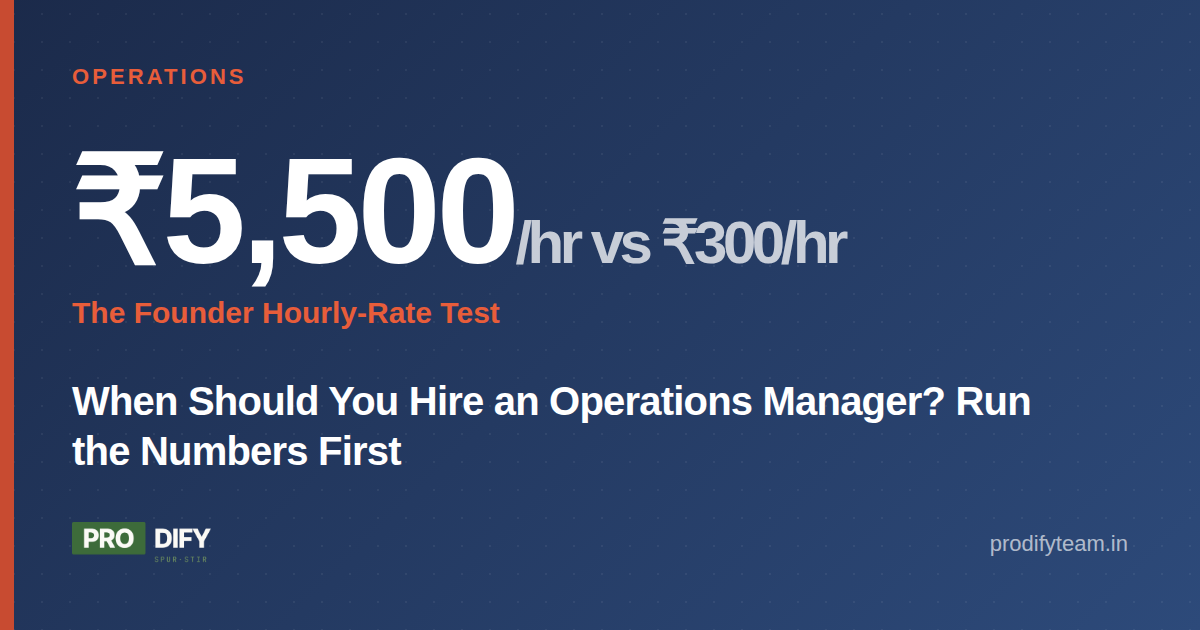
The test shows the rupee gap between what your time is worth and the work you actually do. A founder running a ₹2 crore business on 70-hour weeks has an implied rate of ₹5,500 an hour. Spending 25 hours a week on ₹300-an-hour tasks leaks about ₹65 lakh a year.
Let us run it with real numbers.
Take a founder running a ₹2 crore business, working 70 hours a week. That is roughly 3,640 hours a year. Divide revenue by hours and the implied rate is about ₹5,500 per hour. Every hour this founder spends on anything, the business is effectively billing that hour at ₹5,500.
Now the second half of the test. Track a week honestly and most founders at this stage find 25 hours going to work like this: chasing a vendor for a delayed shipment, approving leave requests, reconciling the day’s collections, following up on an invoice, coordinating between the sales guy and the warehouse, booking travel, answering “sir, ismein kya karna hai?” on WhatsApp forty times a day.
All of it is ₹300-an-hour work. Necessary work, real work, but work the market prices at ₹300 an hour because a competent coordinator can do it.
Twenty-five hours a week is about 1,300 hours a year. The gap between what your time is worth (₹5,500) and what that work costs to buy (₹300) is roughly ₹5,200 an hour. Multiply it out and you get around ₹65 lakh a year of misallocated founder time. In a ₹2 crore business.
Read that again. The most expensive resource in the company is being spent on its cheapest tasks, and the annual leak is a third of revenue. No cost-cutting exercise in your P&L will ever find a bigger number than this one.
The deeper cost does not show up in the math. Those 1,300 hours were supposed to go into the two or three things only you can do: closing the anchor client, fixing pricing, hiring your next senior person, thinking. A founder who spends the day firefighting has no attention left for the fire prevention. That is not a time management problem. It is a role design problem, and the fix is a hire.
What does an operations manager actually cost in India?
A first operations manager costs ₹6–12 lakh a year in India: ₹9–12 lakh in Tier-1 cities like Mumbai, Bangalore and Gurgaon for someone with 5–8 years of experience, ₹6–8 lakh in Tier-2 cities like Jaipur or Indore. Add PF, gratuity, insurance, laptop and recruitment, and a ₹9 lakh CTC becomes a ₹12–13 lakh first-year commitment.
Less than founders fear, more than the CTC number suggests.
For an SMB hiring its first genuine ops manager, the realistic band is ₹6 to ₹12 lakh a year (cross-check current numbers on PayScale). Where you land in that band depends mostly on geography and the complexity of what they will run:
- Tier-1 cities (Mumbai, Bangalore, Gurgaon, Pune): expect ₹9–12 lakh for someone with 5–8 years of experience who can own operations without daily hand-holding. Below ₹8 lakh in these markets you are hiring a senior coordinator, not a manager.
- Tier-2 cities (Jaipur, Indore, Coimbatore, Ludhiana): ₹6–8 lakh gets you comparable capability, often with better retention, because you are one of the few good employers in town rather than one of five hundred.
Now load the cost fully. Add PF, gratuity provision, insurance, a laptop, and the recruitment cost of finding them. Then add the part everyone forgets: three to six months of your own time training them before they generate net value. A ₹9 lakh CTC is realistically a ₹12–13 lakh first-year commitment.
Set that against the worked example above. A ₹12 lakh fully-loaded cost to recover even half of ₹65 lakh in misallocated founder time pays back in under five months. Very few investments available to an Indian SMB return five times their cost in year one. This is one of them, and founders delay it for years while happily spending the same money on a new machine or a bigger office.
Why the delay? Usually not money. Control. “Koi mere jaise nahi karega” — nobody will do it like I do. True. They will do it at 80% of your standard, and 80% done by someone else beats 100% done by a founder who has no hours left to grow the business. If letting go feels impossible, the problem sits upstream of hiring, and it is worth reading how to make your business less dependent on you before touching a job portal.
Should you systemise before you hire?
Yes. Systemise first, then hire. Spend four to eight weeks writing rough SOPs for the processes that repeat: how you quote, how you purchase, how you handle a complaint, who approves what. A manager hired into chaos becomes an expensive messenger because every question still comes back to you.
Yes, and this is where most first ops hires die.
A manager hired into chaos becomes an expensive messenger. If the knowledge of how things work lives only in your head, the new hire cannot decide anything. Every question still comes to you, except now it arrives via one more person. You have added a salary and a delay to the same bottleneck. Six months later the founder concludes “good people are impossible to find in India,” fires them, and goes back to doing everything alone. The hire was never the problem. The absence of systems was.
Plenty of Indian SMBs run beautifully on jugaad in the early years, and that improvisation is genuinely a strength at ₹50 lakh revenue. But jugaad does not transfer. It lives in the founder’s instincts, and you cannot recruit for someone else’s instincts. What transfers is documentation: how we quote, how we purchase, how we handle a complaint, who can approve what up to which amount.
The sequence that works is systemise first, then hire. Spend four to eight weeks writing SOPs for the processes that repeat, even rough ones. A one-page checklist beats a perfect manual that never gets written. Then hire someone to run and improve those SOPs. The manager’s first-quarter job description is literally “execute these documents, flag where they are wrong, fix them.”
Three signs you are ready to hire:
- Your core processes repeat in a recognisable pattern, and at least the top five are written down somewhere other than your head.
- Your hourly-rate test shows 15+ hours a week of sub-₹500 work, and you know exactly which revenue-generating activity those hours would move to. “I’ll be more free” is not an answer. “I’ll spend Tuesdays and Thursdays on enterprise sales” is.
- Cash flow can absorb the fully-loaded cost for twelve months even if revenue stays flat. A hire you might have to reverse in month four damages the team more than not hiring at all.
Three signs you are not ready:
- You are hiring to avoid writing SOPs. This is the most common one. The fantasy is that a smart person will arrive and “figure it all out.” They will figure it out by asking you, one WhatsApp message at a time, and you will have outsourced the documentation work to your most expensive new salary.
- You cannot name what you will stop doing. If the honest plan is that you will keep approving everything and the manager will “assist,” you are hiring an executive assistant at a manager’s price and you will resent each other within a quarter.
- The chaos is upstream of operations. If the real problem is that your pricing loses money or two co-founders pull in different directions, an ops manager will simply run the broken model more efficiently. Fix the model first.
Is a fractional ops person or consultant a better first step?
A fractional operations lead or consultant is the better first step when what is missing is systems, not hands. A three to six month engagement builds the SOPs, review rhythms and dashboards, and can make the eventual full-time hire a ₹7 lakh executor instead of a ₹12 lakh firefighter.
Sometimes. This is the space Prodify works in, so take the trade-offs from someone who sees both sides of them weekly.
The middle option is engaging a fractional operations lead or consultant for three to six months before making the full-time hire. What it does well: builds the SOPs, the review rhythms, and the dashboards with an outside eye, without a permanent salary and without the founder having to be the one who writes everything down. Done properly, it converts a chaotic business into a hireable one, and often makes the eventual full-time hire cheaper, because a well-systemised role can be filled by a ₹7 lakh executor instead of a ₹12 lakh firefighter.
What it does badly: a consultant is not there at 6 pm when the truck has not arrived. Fractional support cannot own daily execution, absorb your team’s culture, or be accountable for this month’s dispatch numbers. If your gap is daily throughput rather than missing systems, a consultant is the wrong instrument and a decent one will tell you so in the first meeting.
The honest sequencing question is not “consultant ya full-time?” It is “what is actually missing — systems or hands?” Missing systems, start fractional. Missing hands and the systems exist, hire full-time. Missing both, which is common, use a short consulting engagement to build the systems and define the role, then hire into it. We have written a fuller breakdown of the full-time versus consultant decision for Indian SMEs if you are weighing this seriously.
When to hire an operations manager: let the test decide
Run the founder hourly-rate test this week. Revenue divided by real hours worked, then an honest log of where those hours go. If the log shows 15–25 hours of ₹300-an-hour work, the question is no longer whether to hire an operations manager. It is only whether your business is documented enough to receive one.
The founders who wait for the “right time” usually mean they are waiting for the courage to let go. Sabr has its place in business, but patience with your own bottleneck is not patience. It is avoidance with a virtuous name.
If you want a second pair of eyes on your numbers and your readiness, book a 30-minute systems call. Bring your hourly-rate math. We will tell you honestly whether you need SOPs first, a fractional lead, or a job posting this month.